Fundamentals
Introduction
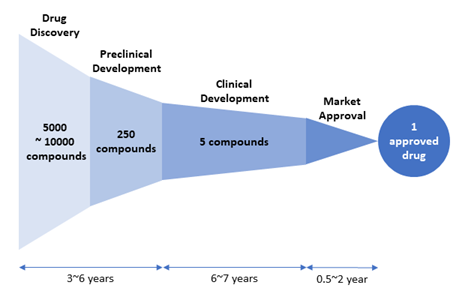
The process of drug discovery and development requires a great deal of resources and time. Bringing a new drug to market (from drug discovery through clinical trials to marketing approval) typically takes between 10 and 15 years and costs on average 1,395 million dollars (2013 dollars) [1]. Figure 1 shows a schematic diagram of the drug discovery and development process.
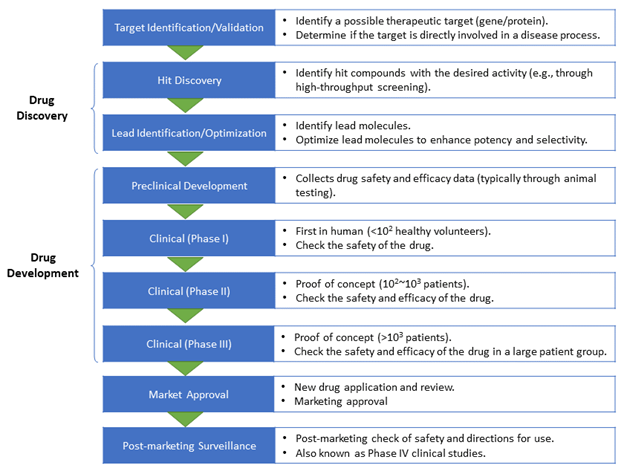
The process shown in Figure 1 is simplified, ignoring many details within each stage. In reality, the drug discovery and development process is much more complicated, as illustrated in this figure 4DM map for small-molecule drug development.
This activity describes some computational approaches used in the drug discovery stage. To delve deeper into computer-aided (or computer-assisted) drug discovery, it is necessary to know the terms commonly used below.
-
Actives
Substances that meet a threshold level of activity in a primary screen, which typically measures the activity of the compounds against the target at a single concentration. Because activity was measured only at a single concentration, it is not possible to know whether a compound can interact with the target in a dose-response manner. Often, the structure and purity of the screening substances are not confirmed.
-
Hits
Hits are compounds with intrinsic activity (IC50, EC50, etc.) against the target and are characterized through secondary assays (which measure the activity of the compounds at multiple concentrations). In general, because hits have limited potency and/or selectivity, they are not suitable for in vivo studies (in animals or humans). However, they provide a starting point for structure-activity relationship (SAR) analysis to help improve the potency/selectivity and other properties of the drug.
-
Leads
A lead represents a compound series that shows a relationship between chemical structure and target-based activity (in biochemical and cell-based assays). The compounds in the series have physicochemical properties, potency, and selectivity that are considered suitable for in vivo evaluation.
-
Drug candidates
Compounds with strong therapeutic potential and whose activity and specificity have been optimized through the lead optimization step. These compounds move on to the preclinical development stage for in vivo testing with animals.